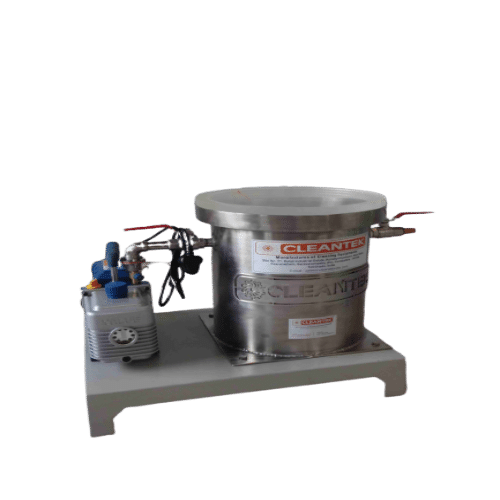
About Vacuum Degassing Unit
Vacuum degassing is a process used to remove dissolved gases from a liquid or material by subjecting it to a vacuum environment. It is commonly used in various industries, including manufacturing, food processing, and scientific research. The primary goal of vacuum degassing is to eliminate unwanted gas bubbles or dissolved gases that could negatively affect the quality and performance of the material or product.
Applications :
removing hydrogen.
Improving cleanliness by removing oxygen.
Producing steel with low carbon content.
Features :
compact in size.
High vacuum suction pump.
Little maintenance.
Advanced Control and SafetyThis vacuum degassing unit incorporates a modern PLC-based control panel with user-friendly HMI, enabling precise control of all operational parameters. With built-in overload protection and emergency shutdown features, the unit prioritizes operator safety and equipment reliability. The seamless integration of these safety systems ensures trouble-free operation even under demanding production conditions.
Efficient and Hygienic DesignFeaturing a vertical cylindrical degassing chamber with a mirror-polished internal finish and a matt external surface, the unit supports Clean-In-Place (CIP) operations for easy cleaning and maintenance. The mechanical sealing system guarantees leak-free, hygienic processing-essential for applications in sensitive industries.
Customizable and VersatileAvailable in single or double stage configurations and with customizable inlet/outlet diameters, the unit adapts to varied process requirements. Its capacity (100-500 L/H), wide temperature range (10C to 80C), and robust stainless steel construction make it ideal for diverse liquid degassing needs across food, pharmaceutical, and chemical sectors.
FAQ's of Vacuum Degassing Unit:
Q: How does the vacuum degassing unit remove dissolved gases from process liquids?
A: The vacuum degassing unit operates by creating a vacuum inside the vertical cylindrical chamber using a rotary vane or vacuum pump. This lowered pressure environment allows dissolved gases in the process liquid to escape efficiently, ensuring effective degassing before the liquid continues to the next stage of processing.
Q: What types of industries commonly use this degassing unit?
A: This unit is widely used in food and beverage processing, pharmaceutical manufacturing, and chemical industries for applications requiring the removal of unwanted dissolved gases from various process liquids, ensuring improved product quality and process reliability.
Q: When is it beneficial to use a continuous vacuum degassing process?
A: A continuous vacuum degassing process is particularly beneficial when large volumes of liquids require degassing without interruption, providing consistent quality and higher throughput. It is ideal for production lines where minimizing downtime and maintaining uniform product standards are critical.
Q: Where should the vacuum degassing unit be installed in a processing system?
A: The unit is designed for skid-mounted installation, allowing flexible placement in processing facilities. It is typically installed upstream of sensitive downstream processes-such as filling, mixing, or packaging-where the presence of dissolved gases could impact product quality or process efficiency.
Q: How is the unit cleaned and maintained for hygiene compliance?
A: The vacuum degassing unit is CIP (Clean-In-Place) compatible, enabling automated internal cleaning without disassembly. The mirror-polished internal surfaces and mechanical seals facilitate thorough cleaning, supporting hygiene standards required in regulated environments like food and pharmaceuticals.
Q: What are the main benefits of choosing this degassing system?
A: Key benefits include efficient removal of gases, automated operation with real-time controls, robust safety features, easy cleaning, compliance with cGMP/EU standards, and customizable configurations to suit diverse application needs. These features deliver enhanced product quality, process safety, and operational convenience.



 English
 Spanish
 French
 German
 Italian
 Chinese (Simplified)
 Japanese
 Korean
 Arabic
 Portuguese






 Send Inquiry


 Send Inquiry


 Send Inquiry
 Send SMS